The Dreaded 10 Pounds
According to an article I read in LiveStrong, the average weight gain per year after age 30 is .6 - 1.7 pounds. If that’s the case, I’m not doing too bad. No doubt there are many factors that contribute to these numbers. But for simplicity’s sake, let’s roll with these numbers. If my memory serves me correctly, I weighed in around 115 pounds in my early thirties. Fast forward twenty years, I’m projected to be 12 - 34 pounds heavier - putting me at 127 - 149 pounds. That’s some span! If I’m going to be completely transparent with you, this is where I share my weight :) To date, I’m 131.2 pounds. That’s a 16.2 weight gain. I guess I shouldn’t feel too bad about this “extra” weight. But it’s not where I want to be.
If you had the opportunity to listen to the All The Things podcast, you’ll know that I’m always doing some kind of workout or workout challenge. But despite my ability to remain active, there’s one thing that has always eluded me on my fitness journey! The last 10 pounds! How do I lose those last 10 pounds so I can get back to the weight where I feel comfortable?
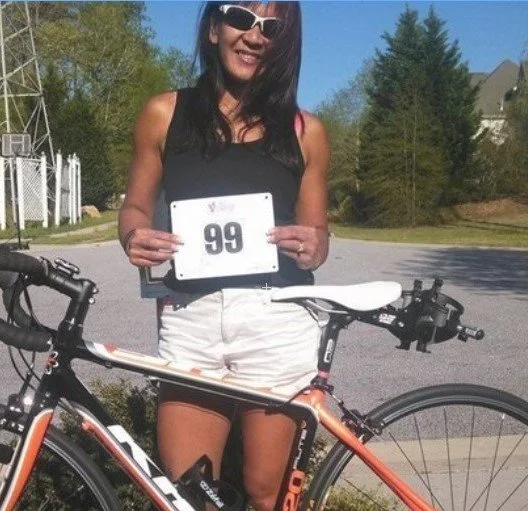
I actually achieved my ideal weight, 113 pounds, back in 2014. This was the Girls Run the World (GTW) sprint triathlon.
Training consisted of swimming, cycling, and running. Weight training was minimal.
I’m not sure what my contemporaries have done to tackle the dreaded 10 pounds. How about those of you in your thirties? What have you done to lose the weight and most importantly, keep the weight off? I would love to know!
According to an article by the CDC, the four main components to achieving and maintaining a healthy weight is healthy eating, physical activity, optimal sleep, and stress reduction. No doubt, there are other factors that affect weight gain, like menopause (errrr…am I at that stage in my life already??). I need to take menopause into consideration for we know hormones can be a significant player in the weight gain battle! As I look over this list, I’d have to say that healthy eating stands out to me as a component that could be derailing my goal to losing the last 10 pounds. I’ve been pretty inconsistent in this area. Though I don’t eat horribly, I can certainly make some improvements! I’m not guilty of eating a bag of chips or cookies in one sitting. Rather I’m guilty of not eating enough. I’m the type of person who will skip a meal or two either because time flies as I’m working or I just don’t feel like making something. So shakes and protein bars are my best friends.
Over the next few months, I will be sharing my journey of tackling (the now more than) the dreaded last 10 pounds. I feel that focusing on nutrition will lead to some positive changes, i.e. healthy weight and overall well-being. My stress level is relatively low and working out is not something I struggle with. Though I am just getting back from a six week hiatus (darn holidays!). Sleep? Yes. I do :) But is it optimal? Let’s table that for now and dive into nutrition.
The first thing to do is create a nutrition plan. For those of you who are just starting out, the following tools are great resources to help you get started and figure out how many calories you should be eating as well as what your macronutrient breakdown is. The two tools I found helpful in calculating my numbers are the calorie calculator and the macro calculator.

I entered my values and chose the Mifflin-St. Jeor Equation to calculate my caloric intake.

Choose How Aggressive You Want To Get
This calculator gives you options to choose from. You choose how aggressive you want to be. I chose Weight loss, allowing me 1375 calories per day.
WHAT ARE MACROS?
Macronutrients make up food. They are Proteins, Carbohydrates and Fats. Below are the values that each provide as a fuel source:
Protein provides 4 calories per gram.
Carbohydrates provide 4 calories per gram.
Fat provides 9 calories per gram.
Next calculate your macronutrients by using the numbers below. (I know, I know. This seems like much, but it really is quite easy!)
Protein = 0.8 - 1.25 grams / pound of bodyweight
Fat = 0.35 - 0.45 grams / pound of bodyweight
Carbs = Fill in the remaining calories with carbs
Here’s how you do it. I am 130.6 pound female, who is active and am calculating the required calories for the weight loss track (1375).
The values above give you a range to work with. Choose a value that falls within that range.
Protein
130.6 pounds x 1.20 = 156.7 grams of Protein
627 calories - taken by multiplying the grams of Protein (156.7) by the fuel it provides —> 4
Fat
130.6 pounds x 0.40 = 52.2 grams of Fat
470 calories - taken by multiplying the grams of Fat (52.2) by the fuel it provides —> 9
Carbohydrates
1,375 calories - 1,097 (protein [627] + fat [470] calories) = 278 calories remaining
Divide the remaining calories (278) by the grams of fuel carbohydrates provide —> 4
69.5 grams of carbohydrates
These values become your daily macronutrient levels:
Protein = 156.7 grams
Fat = 52.2 grams
Carbohydrates = 69.5 grams

To track my macros, I need a food tracker.
I use My Fitness Pal.
I went into Goals/Nutrition Goals/Calorie, Carbs, Protein and Fat Goals. I played around with the percentages until it resembled the values above.
I ended up with the following: 20% carbs, 45% protein, and 35% fat.
Alright. I’ve got my foundation set: calories/day and macronutrient breakdown.
I’ll need to figure out what foods I’ll eat, which workout routine I’ll be doing, when/where do I fit in sweets and alcohol, as well as what supplements to take. I’ll check back and let you know what that looks like.